
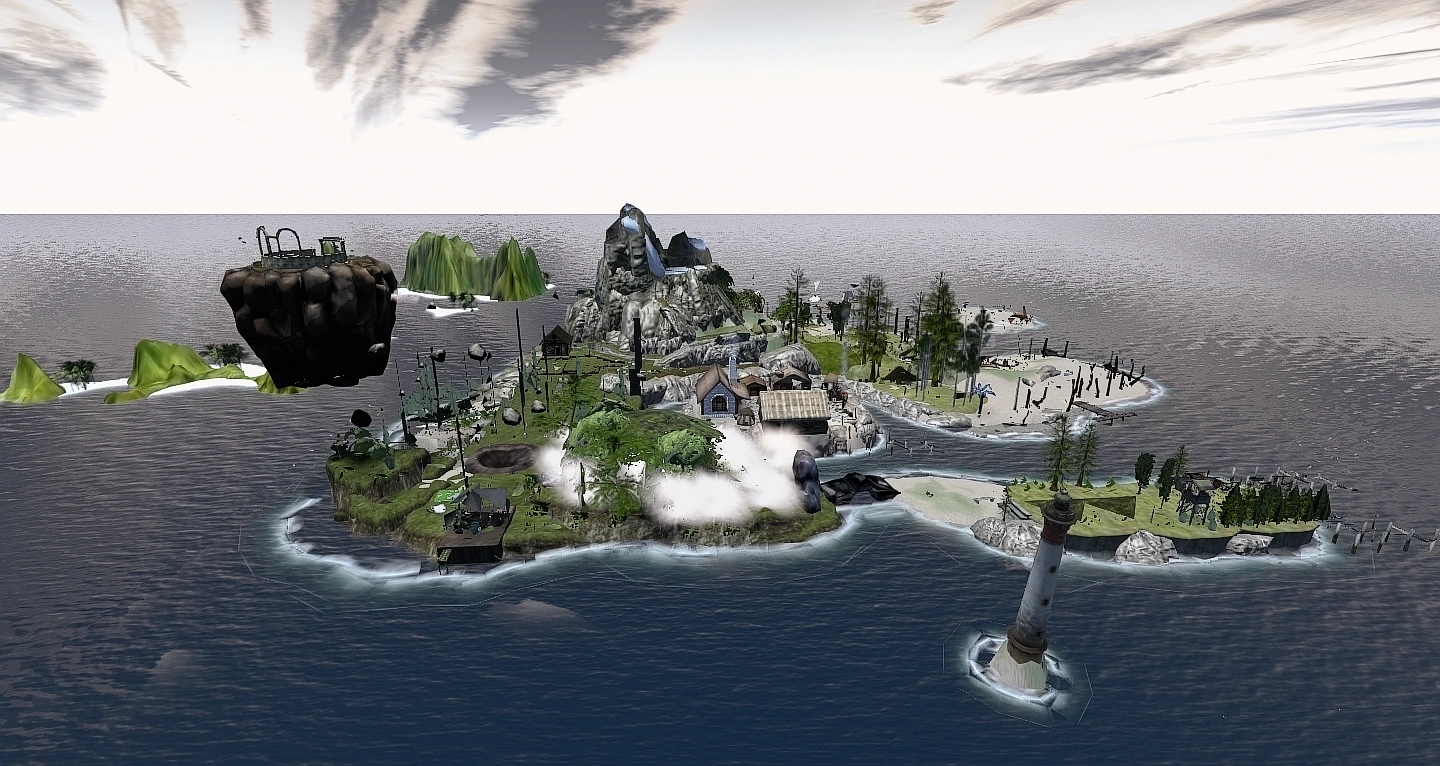
I went to Île de Lumière expecting another Second Life fantasy roleplay region. Then I found a talking sunflower.
That was my first clue that I should probably stop making assumptions.
There are farms and fishing villages here, taverns and caves, mysterious realms, mermaids, witches and plenty of places that seem to be waiting for you to click.
Wander long enough and you begin to realize that Île de Lumière isn’t simply a world built to look at.
It’s meant to be played.

Île de Lumière opens November 1.
Pagan Lane and LeaFy01 own the region, but they didn’t build this world alone. A group of friends and creators helped bring it together.
The setting is loosely Medieval/Renaissance fantasy, but one idea became clearer the more I explored:
Give people reasons to play together.

More Than a Second Life fantasy roleplay Setting
Pagan describes Île de Lumière as an immersive roleplay and social island. But you don’t need a character, a backstory or even an interest in roleplay to visit.
The region is Moderate and 18+, and you’re welcome in or out of character. I spent much of my first visit simply wandering—and that works surprisingly well here.
Forests give way to beaches and fishing villages.
I found farms, taverns, caves, rentals and settlements. I also found stranger places: magical landscapes, an underwater mermaid area, a witch’s home, an Elven temple and realms that Pagan would probably prefer I didn’t explain.
Even if I knew all their secrets.
I don’t.
I did find a talking sunflower.
That seems like a reasonable start.

A Fantasy World You Can Actually Play
Beneath all that scenery is Unity Maxim, created by Warwick Falconer. The roleplay, combat and interactive economy system turns much of Île de Lumière into something you can actually play.
At Lane Farm, I learned that players can grow ingredients for crafting. Food and potions affect your meter. Over in Melorenia, the fish you catch aren’t simply trophies. You can cook, trade or sell them.
At the Grinning Cask Tavern in Caerhaven, players can cook with a working stove and cauldron. Elsewhere I found ingredients to gather and NPCs to encounter. Quests and hunts are planned throughout the region.
Then Pagan took me into the caves.
Glowing lights can reveal part of a quest. Something considerably larger lurks farther inside. And the bats can attack and infect you.
Naturally, you can kill them.
And collect their wings.
And make spicy honey bat wings.
Second Life is wonderfully strange sometimes.

From the Fireside Out
Pagan began my tour at the Fireside, which turned out to be a good place to understand Île de Lumière.
It is the region’s social hub and Pagan’s favorite place on the island. People meet there to talk both in and out of character. Nearby, an eagle totem acts as a transporter, offering destinations across the region.
The destinations also show how much Île de Lumière packs into its Second Life fantasy roleplay world.
Aldea is a small village with rentals. Caerhaven has a library where I could learn more about the region’s lore and characters. It’s also home to the Grinning Cask Tavern.
Frostbreak has a stronger Viking character, while Melorenia takes you to the waterfront. Duskwitch heads farther into another Second Life fantasy roleplay with mermaids, witches and an Elven temple.
And then there is the Realm of Creation.
Pagan described it to me as something of an “end zone” connected to the larger game and the mysteries behind its end game.
I’m leaving that one there.
Some things are more fun when someone doesn’t tell you what you’re going to find.

Building Île de Lumière Together
Although Pagan and LeaFy are the owners behind Île de Lumière, the region itself is very much a collaborative build.
LeaFy serves as creative director. She created special systems and scripting for the sim’s Second Life fantasy roleplay by using Unity Maxim, and she and Pagan worked on the terraforming.
She also created one small detail I particularly liked. When I teleported into a new area, its name appeared briefly on my screen and then disappeared. Simple, useful and unobtrusive.
Ceakay Ballyhoo (CK) helped shape the island, villages, forest and mines. During my tour, Pagan specifically pointed out her work in Frostbreak and the caves.
TianD22 (Sebastian) contributed interiors and gathering spaces, including the Grinning Cask Tavern. Outside Île de Lumière, you’ll also find his work at Saint Sebastian Vineries Main store & Gallery.
Birog (Amestris) and Silverwing13 (Slifer Drch’tares) helped build the desert island of Kazesh. Slifer also created its teahouse.
When I tried to pin Pagan down on exactly who had built one particular area, his answer was probably a better description of the project than a list of credits could ever be:
“It was a collaboration. Hard to tell when one ends and another begins.”
That feels important here.
Île de Lumière doesn’t look like a collection of individual builds placed beside one another. It feels like people have been building a shared world.

Places for People
Second Life fantasy roleplay is only part of the idea behind Île de Lumière.
Pagan and LeaFy are also creating places for people to gather when they aren’t farming, fighting bats, chasing quests or roleplaying.
Pagan showed me The Wandering Star, a music and social venue with space for DJs, live performers and games. He tells me the club has a longer Second Life history and has moved between regions over the years—a story worth saving for another day.
The Snug is a more intimate gathering space and will showcase the work of one artist at a time.
I also found rentals and spaces meant specifically for out-of-character gathering. Larger events are coming too.
Pagan has plans for a Conquest Invasion event with capturable flags. A separate story event will kick off the region’s main quest.
You can tackle some Unity Maxim content alone. Pagan says other achievements will be difficult enough that you’ll want to bring friends.
That is where all the pieces start making sense.

A World That Doesn’t Want to Keep You
There was one answer Pagan gave me before my visit that stuck with me.
For a region with this much packed into it, Pagan and LeaFy don’t expect you to spend all your Second Life time there.
In fact, Pagan says the community takes field trips to other regions.
That may sound like a small thing, but I like the philosophy behind it. Île de Lumière isn’t trying to become a wall around its community.
Pagan and LeaFy want friends to gather here, meet people, roleplay and play together. Then go explore the rest of Second Life too.
That also helps explain why the Fireside is Pagan’s favorite place.
The place where people sit together.

Île de Lumière Second Life fantasy roleplay Opens November 1
Île de Lumière officially opens November 1, 2026. What I saw was still a world approaching its public opening.
There are quests and events still to come. I haven’t solved its mysteries, and there are quite a few corners I haven’t explored.
That’s probably for the best.
Because Île de Lumière isn’t really something that needs to be explained room by room.
You can arrive without roleplaying and simply wander. Follow whatever strange thing catches your attention. Eventually you realize that much of the scenery is inviting you to do something.
Fish.
Farm.
Cook.
Fight something.
Follow the fog.
Talk to the sunflower.
Or sit down at the Fireside and meet somebody.
There are systems, lore, fantasy landscapes and plenty of things waiting to be discovered. But that last possibility may be the most important part of what Pagan, LeaFy and their friends are building here.
A world to play in—and people to play it with.
Visit Île de Lumière
Opening: November 1, 2026
Rating: Moderate — 18+
Second Life fantasy roleplay: Fantasy / Medieval-Renaissance; in-character and out-of-character visitors welcome.
Visit – Île de Lumière


Leave a Reply