
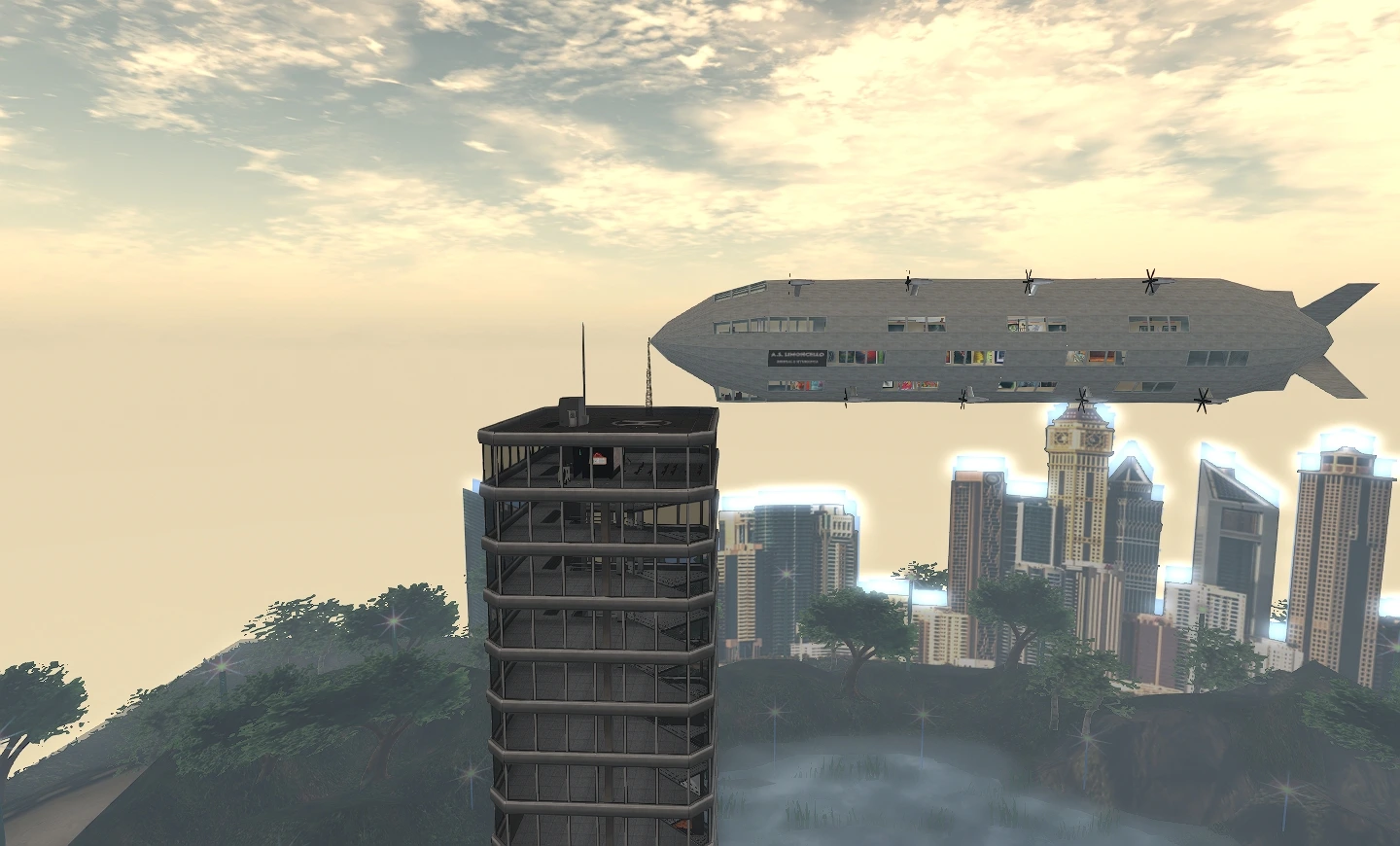
The Limoncello Art Gallery began in the cargo hold of an airship.
That seems an appropriately Second Life beginning for a collection that has spent nearly two decades growing alongside the virtual world around it.
What started as a small collection of art displayed for residents living on a handful of mainland regions has expanded far beyond that original cargo deck. Today, Limoncello stretches through a towering gallery, the original 120-metre airship, Bellisseria and an arts district surrounded by a landscape inspired by Scotland’s Isle of Skye.
Inside is a collection gathered since 2007—not around a particular style, medium or artistic movement, but around something much more personal.
Art that meant something to the people who collected it.
For owner and curator Dave, Lord Junibalya, wandering through Limoncello Art gallery today is like walking through what he calls “a living diary of our times in SL.”
And that may be the best way to understand this extraordinary collection.

An Art Gallery in the Cargo Hold
Limoncello’s story begins with LastDitch Writer, who owned several rental regions on Satori during Second Life’s early years.
The rental business was not particularly successful, but LastDitch tried some wonderfully Second Life ways of making it more interesting. His tenants could live on a space station or rent cabins aboard a 120-metre airship—at the time, according to Dave, the largest moving vehicle in Second Life.
The airship was named The Limoncello, after a friend who blogged as Welshcakes Limoncello.
LastDitch also began collecting art.
At first, he displayed it on the airship’s open cargo deck where residents living on his land could enjoy it.
That cargo deck became the first Limoncello Art Gallery.
As the collection grew, the rental business eventually disappeared. Most of the land was sold. The cabins aboard the airship were removed and its upper and middle decks became galleries.
Then, following the death of LastDitch’s wife in 2011 and his departure from Second Life for a time, the collection passed into the care of Dave (Lord Junibalya).
There was one important consideration.
He didn’t want the art to disappear into inventory.
That decision allowed Limoncello Art Gallery to continue.
Inara Pey documented the gallery’s later Bellisseria incarnation in 2020, describing both its origins aboard the enormous airship and the private collection then being cared for by Lord Junibalya.

Limoncello Art Gallery A Collection That Kept Growing
Dave and his co-curator Fenella continued collecting.
They visited exhibitions. They bought work they loved. Eventually the collection outgrew the airship.
So they built a tower.
Then came Bellisseria.
Dave opened a small Limoncello branch from his houseboat, connecting it to the other gallery spaces with teleport doors. The little Bellisseria gallery proved remarkably successful at bringing visitors to the collection; Inara Pey’s 2020 visit captured Limoncello at this earlier stage of its expansion.
The collection kept growing.
Today the LG Tower rises from Nyunanga amid Manda Vale, an urban arts district created by Dave, while the surrounding NyuSkye landscape was designed by artist AmandaT Tamatzui and inspired by Scotland’s Isle of Skye.
And above it all is the original Limoncello Art Gallery airship.
Still filled with art.

A Living Diary of Second Life
For all its size, Limoncello does not have a grand collecting theme.
Dave’s rule for buying art is much more personal.
“If I put that on the wall of my RL home, would my life be richer for living with it?”
That same question has guided LastDitch, Dave and Fenella over the years.
The result is not an academically organized history of Second Life art.
Perhaps it is something more interesting.
The collection reflects changing tastes, friendships, discoveries and moments in Second Life. Some works were purchased simply because they were loved. Others came from friends. Sometimes buying a piece was a way of encouraging an artist who needed support.
Dave doesn’t apologize for those inconsistencies.
“Every piece means something.”
Walking through Limoncello, he told me, is “like a living diary of our times in SL.”
And it is quite a diary.
The current catalog reaches from works dating to Second Life’s early years through photography, digital art, painting, sculpture, installations and contemporary work created using newer technologies.
The changing art becomes part of the changing world around it.

What Second Life Made Possible
Looking back across the collection also brought Dave back to something fundamental about Second Life itself.
Philip Rosedale created Second Life as a world where its residents could make things without anyone knowing exactly what they would make.
What followed was what Dave describes as the:
“exuberant, anarchic joy of the place.”
Art was one of the things he didn’t expect to find.
Once he did, it changed the direction of his Second Life.
“My Second Life has—in consequence—largely been lived among its artists.”
Dave describes himself, with considerable affection, as a muggle—someone without the creative spark to make the work himself.
But collecting became another way of participating.
And eventually, so did sharing.

Art Shouldn’t Disappear Into Inventory
This may be my favorite part of the Limoncello story.
Dave once visited the basements of the Hermitage in St. Petersburg, Russia, and saw treasures stored away that could, in his estimation, fill museums elsewhere.
Years later, he recognized a Second Life version of the same problem.
Residents collect art.
Then much of it sits unseen in inventory.
With empty floors available in the expanding LG Tower, Dave borrowed an idea from physical-world museums: loaned private collections.
Collectors could bring some of the art they had gathered out of inventory and put it somewhere other residents could experience it.
Today, several floors of the tower are devoted to these collections, including works on loan from JMB Balogh, Sisi Biedermann and my own Dragonash Collection.
My collection occupies the first floor, where I rotate the art a few times a year. It is a small part of the much larger Limoncello collection, but being part of it has given me a different way to think about the art we collect in Second Life.
A work we love doesn’t have to disappear into inventory when we run out of wall space.
At Limoncello, it can become something another person discovers while wandering through the gallery.
The art gets another life.

The Muggle’s Contribution
Limoncello remains primarily a private collection opened for the public to enjoy rather than a commercial gallery.
But supporting artists has become part of its purpose.
Special exhibitions can allow artists to sell their work without commission, and a newer Bellisseria commercial space gives artists represented in the collection another commission-free place to offer their work.
The collection itself continues to grow.
There are still empty floors waiting.
And perhaps that is appropriate, because Limoncello doesn’t feel finished.
It feels lived in.
When I asked Dave what Limoncello means to him today, his answer brought everything—the airship, the tower, the hundreds of works and nearly two decades of collecting—back to something very simple.
“It’s my muggle contribution to the SL art scene.”
And then he told me something else.
When life is difficult, Limoncello is somewhere he goes to feel better about the world.
Art, he believes, gives us one of our few opportunities to glimpse another person’s experience of being alive. We cannot know whether another person sees the colors we see or hears the notes we hear. But through what they create, for a moment, we can look through someone else’s eyes.
Perhaps that is what Limoncello Art Gallery has really been collecting all these years.
Not simply paintings, photographs or sculptures.
Ways of seeing the world.

Visit Limoncello Art Gallery
LG Tower & NyuSkye / Nyunanga
Visit Limoncello Art Gallery
Limoncello Gallery — Bellisseria
Limoncello Friends Flickr Group
Explore the Limoncello Flickr group


Leave a Reply