
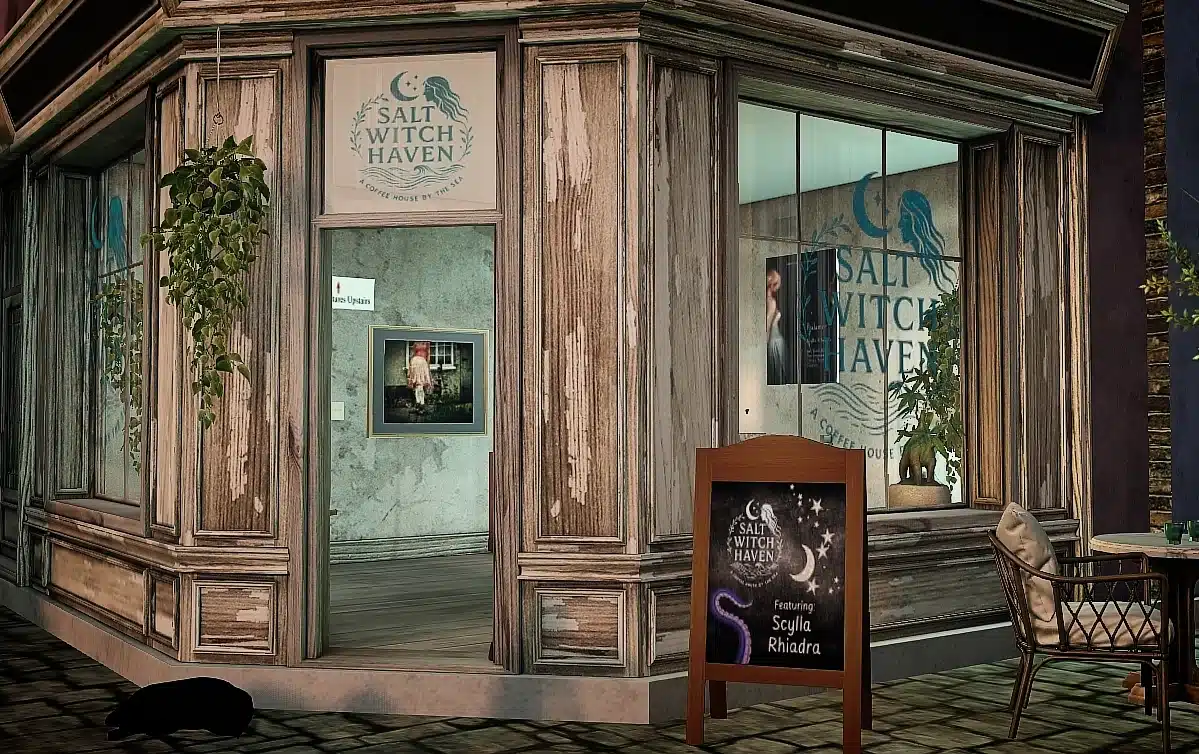
My first encounter with Scylla Rhiadra was several years ago through Intimacy, an exhibition exploring identity, self-representation, and the ways our virtual selves can reveal truths about who we are. I don’t remember every image from that visit, but I do remember leaving very impressed.
Since then, I’ve crossed paths with Scylla’s work more than once. When I invited her to exhibit at Salt Witch Haven, I saw it as an opportunity to spend some time exploring her work more fully.
What followed was one of those unexpected journeys Second Life does so well.
A current exhibition led to older ones. Artist statements led to exhibition catalogues. One discovery led naturally to another, until I found myself exploring galleries, installations, and years of thoughtful writing about her work.
Along the way, I found myself revisiting past exhibitions through Scylla’s own notes and through years of thoughtful coverage by Inara Pey.
The deeper I looked, the more I found an artist whose work rewards reflection and invites conversation.
What emerged was not simply a collection of photographs, but the work of an artist who has spent years exploring questions of identity, memory, storytelling, relationships, philosophy, and ultimately what it means to be human within virtual worlds.

Finding the Human in a Virtual World
A resident of Second Life for more than seventeen years, Scylla Rhiadra has focused on photography since 2018. Much of her work is avatar-centered, but her interests go far beyond portraiture.
As she writes in her artist statement:
“How can we retain the things that reflect the complexity and uniqueness of real life identity — emotions, connections, our dynamic engagement with the world — in a simulation that, to varying degrees, constrains the expression of these things?”
It is a question that appears again and again throughout her work.
Whether exploring movement through dance, relationships between people, the spaces we inhabit, memory, loss, philosophy, or social issues, Scylla’s work consistently returns to the question of what it means to be human.

More Than Photography
One of the most striking things I discovered while exploring Scylla’s exhibitions is that the photographs are only part of the experience.
Many exhibitions include artist essays, literary references, program notes, catalogues, or accompanying texts. Yet these rarely function as explanations. Instead, they open additional avenues for thought and interpretation.
In Containers, Scylla Rhiadra reflects on our relationship with the spaces we inhabit and the ways those spaces help shape our identities.
In An Emptiness that Is an Echo, she presents fragments of a relationship between two women, deliberately leaving the story incomplete so viewers can bring their own experiences and interpretations to what they see.
In Poems on Pictures at an Exhibition, poet ZuHicksley responds directly to Scylla’s photographs, creating a dialogue between image and poetry inspired by Modest Mussorgsky’s Pictures at an Exhibition.
Again and again, the same idea appears:
Art is not a monologue.
It is a conversation.

Balance By Scylla Rhiadra
The current exhibition at Salt Witch Haven offers a wonderful example of Scylla’s approach to art and storytelling.
Drawing on the imagery of dance, movement, and physical expression, Balance explores identity through posture, gesture, reflection, and form.
What struck me most was the way the images communicate through body language rather than facial expression. Faces are often turned away, partially hidden, or lost in shadow. Instead, meaning is carried through movement, posture, and the relationship between figure and setting.
The exhibition space itself reinforces these ideas. A ballet barre runs through the gallery, and visitors can even try ballet poses of their own. The result is an exhibit that feels less concerned with performance and more interested in the emotional language of the body.
Like much of Scylla’s work, Balance does not tell viewers what to think. It invites them to pause, look a little longer, and bring their own experiences and interpretations to what they see.

The Theia Gallery
To gain a deeper understanding of Scylla’s work, visitors should also make time for a trip to the Theia Gallery in Bellisseria.
Part café, part gift shop, and part gallery, Theia is a welcoming and thoughtfully curated space. During my visit, I found myself lingering longer than expected. One room leads to another, exhibition notes invite closer reading, and catalogues preserve ideas that might otherwise disappear when an exhibit closes.
Alongside selections from Scylla’s earlier work, visitors will find artist statements, thematic groupings, and reflections that encourage deeper engagement with the ideas behind the images. It feels less like a traditional gallery and more like an archive of an artist’s ongoing conversation with her audience.
The gallery also supports other artists. During my visit, guest artist Mareea Farrasco was featured alongside Scylla’s own work, reflecting a commitment to community as well as creativity.
Throughout the space are reminders that “Art Matters,” a simple statement that seems to capture the spirit of the gallery itself.
Beyond her own gallery, Scylla has also been working to help connect Bellisseria’s artists and gallery owners through shared resources and community-building efforts, reflecting the same spirit of engagement found throughout her work.
Theia feels less like a sales venue and more like a place devoted to thoughtful engagement with art.

Ideas, Stories, and Questions
Over the years, Scylla’s work has appeared at some of Second Life’s most respected galleries, including Nitroglobus, IMAGO Art Galleries, Onceagain Art Gallery, and Kondor Art Square.
The exhibitions themselves have ranged widely in subject matter.
Swerve explored ideas inspired by the Roman philosopher Lucretius and questions of free will and human agency.
Almost used Zeno’s paradoxes as a starting point for reflecting on the process of becoming and the unfinished nature of human existence.
Virtual Toxic examined difficult questions surrounding toxic behavior and hypocrisy within virtual communities.
Yet despite their varied subjects, these exhibitions share a common thread. They are less interested in providing answers than in encouraging reflection.
Throughout her work, Scylla’s photography feels less like documentation and more like a way of exploring ideas, stories, emotions, and experiences. The photographs may begin with a question, but they rarely insist on a single answer.

Owl Notes
After spending time with Scylla’s work, what impressed me most was the care behind it all.
These images are beautifully crafted, but they are also thoughtful. The use of shadow, setting, composition, and narrative reveals an artist who spends as much time thinking about ideas as she does creating images.
Whether exploring philosophy, memory, relationships, movement, or difficult social questions, her work reflects a depth of thought and curiosity that encourages viewers to look a little longer and think a little deeper.
I came away with a genuine appreciation not only for the artistry itself, but for the seriousness with which she engages both her subject matter and her audience.
In the end, I realized I wasn’t only looking at photographs. I was taking part in a conversation that Scylla has been inviting viewers into for years.
The photographs may begin the conversation.
But they rarely end it.
Learn More
- Visit Balance at Salt Witch Haven, Port Emyniad & Enchanted Forest
- Visit Theia Gallery in Bellisseria
- Explore Scylla Rhiadra’s Flickr Gallery


Leave a Reply